Welcome to the world of Candy Blowing, Hou Goa Yi seems to say. As I stood fascinated watching him do his act, I really thought he is in the world of his own.
In front of his exhibition booth in Gurney Plaza Penang, Hou Goa Yi has all the animals in the zodiac signs in a glass like golden state.
As I wandered nearer, seeing a horse but look more like a reindeer, he presented it to me. Then within seconds, he blew and turn a monkey, then stuck the monkey on my horse.
He then explained in Mandarin that a monkey sitting on a horse indicated for the working class people, a sign of promotion. I thought that was a brilliant gesture he did.
The Chinese have an enchanting way to extend their good wishes and this I feel is simply brilliant great one.
He further took a dollop and knead it into a ball, shaping and pulling same time to pull it longer. Using his mouth, he nipped it off.
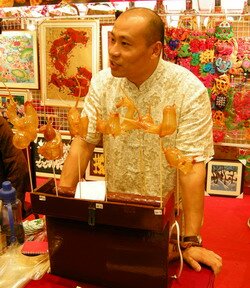
Curious, I watched how at one end, he blew and turn, blew and turn till it was fashion into something familiar. One hand shaping the ball, the other shaping the required shape.
Before I could understand or comprehend what he is doing, this expert candy blowing man has a semi transparent golden animal stuck in a dollop stick to present to me again. It was simply magical.
What a time I had. Many adults and kids stood amazed with awe as he blows, pulls his craft candy. This is where is real art begin, your mouth and hands.
It was amazing to see Hou Goa Yi at work and Mr Phoon, the organizer told me, there exist only a few of them in China specialize in this art.
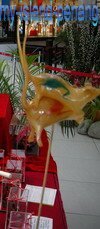
Few in this fast-moving, materialistic world realize how quickly folk traditions and the handicrafts they produce are dying out. It seems the folk craft of candy blowing was once a common sight all over China but now it is nothing more than an item of nostalgia.
So when you are in Queensbay or Gurney Plaza, don't miss the opportunity to see this art, only a few people in the world would know how to do.
The History
Candy blowing is believed to have begun in the Tang Dynasty (618-907) "That's one reason why the craft is called tang ren," he jokes.
The character for Tang (referring to the dynasty) in Chinese is pronounced the same as that for candy, and ren means person, in this sense referring to the raftsperson. The two words name the craft and are also an abbreviated form of address for its masters.
The birthplace of blown candy is, as Hou Goa Yi proudly confirms, his hometown of Dezhou in Shandong Province.
Watch Hou in action in Queensbay or Gurney.
His story
Born into a family of traditional candy-blowers, Hou Goa Yi learned the craft from their father, who was taught by his father.
Their grandfather was a crack candy man who carried his wares in two baskets at either end of a pole through cities and towns throughout China.
At the age fifteen, he left the village for Tianjin, a folk handicrafts center. Learned the candy blowing trade, prefect it in many different styles and mastered the skills further.
Hou Goa Yi became quite a fame around Beijing for many years. Recently, he was commissioned to Malaysia to exhibit this folk art leaving his wife Lee Ai Hong and two daughters in Beijing.
Though he worked very hard, life was not easy as candy blowing is slowly diminishing from China.
Now watch Yei Yei from Sydney who tries blowing the maltose.
We asked whether he would teach his two daughters the art and this was a difficult answer for him as even he feels a better future with new technology of blowing has to be perfected.
Hou agrees his trade is totally different from Dough Figurine where Master Xu has perfected it which can be stored for years now. Also looking at paper cutting items which is already a favorite in Penang, he hoped there is no stopping people wanting to learn this Chinese art.
Being young, Hou knows he has time to make this art into an object that can be preserved for display. Things he might need to look out for ants who will eat his arts away even if humans tries hard not to.
Though presently he is no short of fans and customers admiring and appreciating him at work and continue his quest to preserve his home land folk art.
Go to Top of Candy Blowing Page
Back to Dough Figure Sculpturing Page
Back to more photos of Dough Sculptures Page
Back to Chinese Paper Cutting Page
Back to My Island Penang Home Page