My second trip up the Penang Jade Emperor Temple or Thnee Kong Thua, has been the most memorable visit I done so far.
Probably because there was no crowd, it was very quiet and very peaceful. The kind of serenity and tranquility I always find it exist in Penang.
Penang Jade Emperor Temple is what the Hokkiens would say "Cheh Sauh Kuah Hai"(sitting on the mountain, watching the sea).
The incense and joss sticks in this temple smells different. Maybe, I was paying attention to the fragrances permeating throughout the Penang Jade Emperor Temple. You can actually feel you are on a different level on the Penang Jade Emperor Temple.
In this page, you will find:
- My present discovery
- The Lost writings of Penang Jade Emperor Temple
- The 40 years prediction
- Lower Hall
- Upper Hall and Imperial Throne
- Upper Roof Top
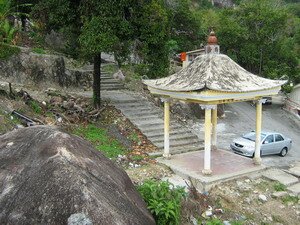
Walking up the steps, I now see on my right, the old steps that was demolished. I used to run walk and play around these steps. Read my first trip a few weeks ago here.
A mangos teen tree and a few rambutan trees are evident. We used to climb these trees. It stood in front of the steps leading up the temple.
You can walk the old steps if you park your car here to the temple. There is ample parking space now for the devotees, especially the older folks.
Presently, I saw four areas for parking your vehicles. Driving uphill further up the road, you can park behind the temple. No climbing or walking on stone slabs is needed, step out of your vehicle and into the temple ground.
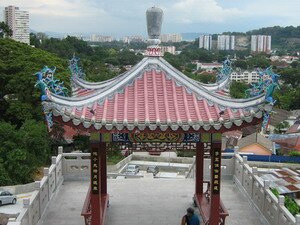
The second place is shown in this photo. Then the third and fourth is a newly built parking area costing RM600,000. So when you park here, a charge of RM2 is taken from you but it goes to the temple funds.
When I walked up the steps, it suddenly dawned to me how come there seems to have two kinds of architectures, Hokkien and Cantonese.
As I stopped to rest, one gets to admire the view of Air Itam, Penang. The newly built gazebo has a Hokkien shape roofing rounded "tomb like" on the top of roof. The ends of four corners does not have a sharp ending, unlike the main entrance gate.
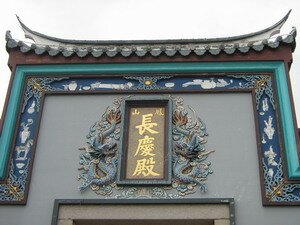
The Penang Jade Emperor Temple or Thnee Kong Thua Temple renovation led by Chinese architecture specialist Wang Zhong Yi, underwent extensive renovation and restoration which began in January 2002.
It is now placed majestically on the main entrance of the Penang Jade Emperor Temple, across a eight acres land, surrounded and protected by the four sacred creatures of Taoism green dragon, white tiger, black turtle and red peacock.
As the craftsmanship is not available locally, artisans from China had to be employed. They included 33 craftsmen from Fuzhou.
The people who are involved in the restoration are also the ones who worked on the award-winning Thian Hock Keng Temple in Singapore. The restoration of the Thian Hock Keng Temple received an award from Unesco for cultural heritage conservation.
The craftsmen seems to feel something were not right. When they started work in year 2002 as they could not find the Temple writings.
So they kept looking for days, as prior to 2002 restoration, the temple had a local restoration done in 1996 but since it was a bad job done, they scrapped the project.Penang Jade Emperor Temple
So what happened is that the 1996 restoration efforts left all work undone. Fortunately all bits and pieces in the temple surroundings were not stolen.
This craftsmen looked through the debris and couldn't find it at all. But one day, they saw a nun washing on a long piece of a stone slab, which has some writing.
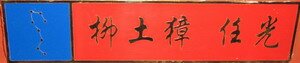
You can imagine how shocked and happy they were when they found this stone slab with the Temple name written on it. So the craftsmen restored to its former glory.
Well now comes to the part why 1996 restoration it didn't work out. Not only the craftsmen unearth one item, they unearth a prediction done way back 1964.
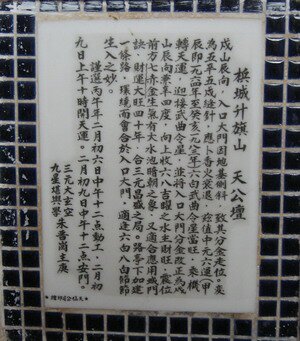
The feng shui master has advised that the winds of change will happen in 2004. So when the old main gate caved in and open a bigger path in a different part of the temple in 2004, the trustees decided to have the main gate in that position.
But they didn't find this predictions then. After work started in 2002, took two years before the ravine caved in year 2004.
It was already being written that only after 40 years, these can happen. That is why I said in my earlier visit, this temple is alive!
The Eight Trigrams is used to predict cosmic phenomena happened in this temple. The Chinese regard the Yin and Yang as the basic law of the universe and used the concepts to explain social phenomenon's.
Also in my opinion, the writing on the stone slab was not found then. So how could they built an entrance without the auspicious writing of "Jade Emperor sitting on the Phoenix Mountain".Penang Jade Emperor Temple
And indeed nothing in the cosmos remains constant. Everything is in the process of change. And these changes are ordered and sequential. It is only befitting to install the stone slab with the "writings" up on the main entrance.
Some things are not easy to explain. But having listen to all the wonderful experiences shared by the trustees and craftsmen, one can only be grateful to the "wonders" of god's arrangements.
And the way they glorified all the timings and arrangements, I can only listen in awed and indeed I am awe inspired by God's wonders and arrangements.
Penang Jade Emperor Temple or Thnee Kong Thua has a beautiful history. In the old days, the temple was taken care by a Buddhist monk named Abbot Jing Ming, a Mahayanist monk. He was the abbot of Thnee Kong Thua from 1905 to 1915.
You can see Buddha statue at the lower hall as you enter the main entrance. This Buddhist monks though, he practiced Buddhism, guided the locals to offer prayer to the Jade Emperor. Strange but true!
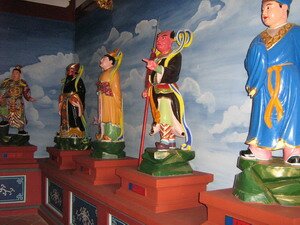
Now you can walk up to the upper hall by the left or right side from the lower hall. As you walk up, on the left and right side of the temple, it houses the 28 Chinese constellation star gods.
If you want to know who they are, read the writings written at the bottom of each statue.
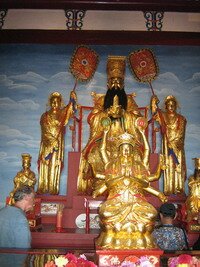
Now after looking through both sides of the upper halls that houses the 28 constellations star gods, you reach the main hall that Jade Emperor (Thnee Kong) sits.
So to reach this level to look, visit or pray, one has to understand that you have passed through so many levels of Gods and sub gods before coming up to the Heavenly Father Imperial Throne.
In front of the Jade Emperor is Dou Mo or Hokkien some mistook her for Ma Choe Poh, the seafarer patron saint. In hierarchy, she is much more than that.
The Heavenly Father, Thni Kong is the highest ruler in the Taoist Heavens. He ranks beneath the 3 Pure Ones. The Jade Emperor often holds a pointed slab of jade in his hands as a symbol of his authority.
The Jade Emperor's birthday is typically celebrated on the ninth day of the first lunar month, which corresponds roughly to the first day of spring.
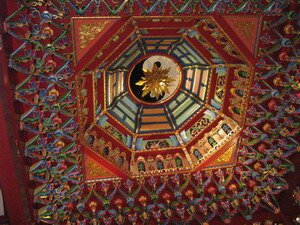
As you can now feel you are in the imperial court of the Heavenly Father or Penang Jade Emperor Temple. Shading his throne are the Ying Yang and the Five Elements, Eight Trigrams Dome ceiling depicting the universe, the only kind in Asia.
I stood in awed with the skills of the craftsmen. The colors of red and gold are painstakingly done layer by layer.
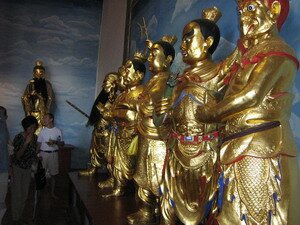
So for devotees seeking protection for their life, they would pray to the God of Time (Tai Say Yeh) You will also observe, his foot is most rubbed. No longer has the gold shining look. The 5th statue in this group.
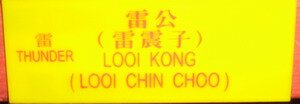
On the left hall, it houses 15 gods and on the right hall, it houses 13 gods. The superstitious Chinese are particular in placing 14 in each.
It is worth a visit even if you have to climb the steps to the temple as there exist only two Taoist temples in Penang that has magnificent bronze like statues.
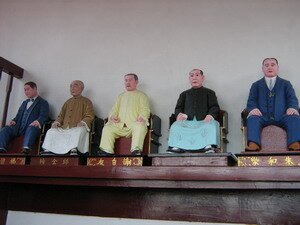
I felt very privileged to be invited up the upper roof where the founders statues can be found.
As we chatted, names of the founders were mentioned. Their names are familiar and some descendants are alive and still living in Penang. They are like me, in their fourth or fifth generation.
The big bell for ringing through the whole valley is in this part of the temple. Hearing the bells ringing is as if the founding members seems happy to know some of their descendants are around and paying homage to them.
Go to Top of Penang Jade Emperor Temple Page
See more photos of Jade Emperor Hokkien New Year Day
Back to Places of Worship Page
Back to My Island Penang Home Page