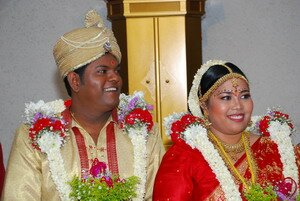
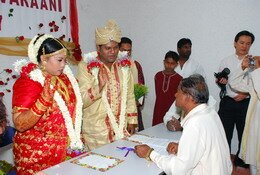
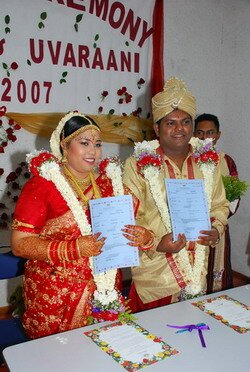
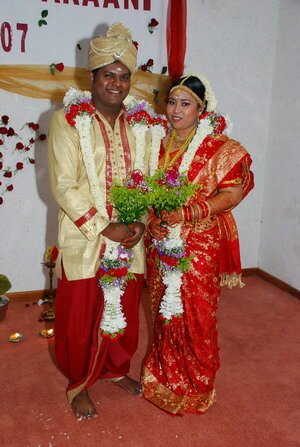
What about having an Indian Wedding in a Buddhist Temple? Here I shared Uvaraani and Jivan Thali Tying ceremony in Sungai Petani, in the presence of the Sokkai Gakai Dojo Chief.
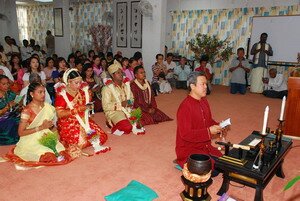
Being the centre chief, Uvaraani and Jivan had a Buddhist wedding ceremony with a twist. Thali tying the Indian way to complete the Buddhist ceremonial rites was performed as agreed by both parents.
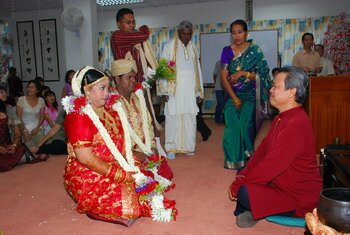
For Jivan's mum, to actually see Jivan married in the dojo is a dream come through and she really planned it so well.
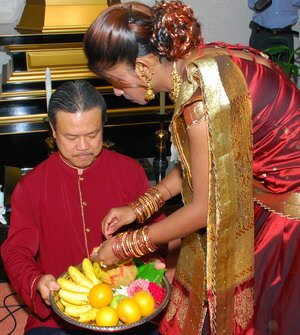
The support shown by the friends, turning up in full force and support speaks a lot of the organization. They were there to greet and usher the guests.
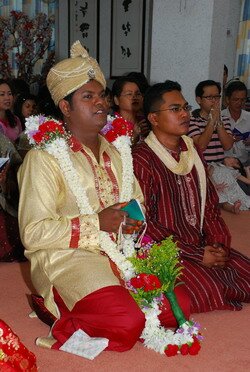
The Wedding Day
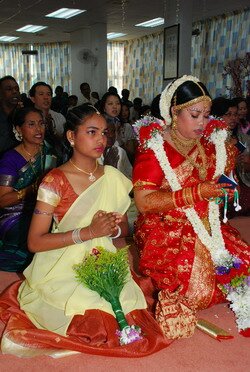
If you are around in the mornings of both wedding houses, you would realized a tornado had hit it. Everyone was rushing to get everybody ready.
Food have to be served for the groom entourage coming to fetch the bride. At the same time the bride's brother or the male entourage, leaves the bride residence to invite the groom to the designated location for the wedding, sometimes a temple or hall.
Both the bride and the groom then arrive at the designated location for the wedding proper. Usually the bride arrived first and will be ushered to another part of the hall.
After the morning ceremonies, the groom and his entourage will arrive at the wedding hall. This is a very colorful festive celebration with the drumming and trumpeting of the Nadaswaram as the groom is paraded to the hall.
Then the bride with her cuties (bridesmaids)led again by the trumpets and drummers of the Nadaswaram blasting away enters the matrimonial hall.
The Buddhist matrimony rites
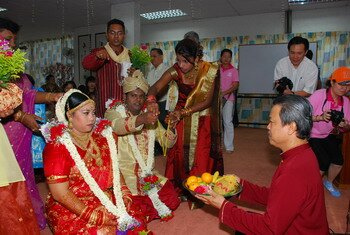
Jivan then takes his place, and sit patiently waiting for his bride to enter. Followed by Uvaraani. this is an unusual Indian wedding as you don't see the groom going off to temple to pray or the bride having a change of engagement sari to wedding sari.
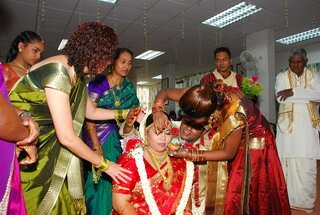
Those Indian rituals were omitted so you see both the couple in full wedding attire ready for the wedding but with a great difference. All present including the bride and groom kneel in front of the holy altar and before their dojo chief.
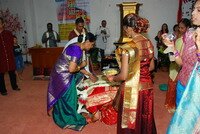
A half hour session of chanting mantras concluded with the Indian relatives passing the "Thali tray" around for the elders to bless. It was brought back to the chief who now officiated over the Thali tying ceremony.
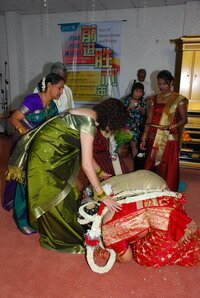
As the chanting was going on, I can't helped but remembered the Indian mantras which translated the seven step and prayed that it is also in the Buddhist mantras for the newly weds:
Ye who have walked with me, become my companion,whereby I acquire your friendship. We shall remain together-Inseparable. Let us make a vow together. We shall love, share the same food, share our strengths, the same tastes. We shall be of one mind. We shall observe the vows together. I shall be the Sama and you the Rig. I shall be the upper world and you the earth. I shall be the sukhilam and you the holder. Together we shall live, beget children and other riches. Come thou, o sweet worded girl.
Indian Rites and Thali Tying
The tying of the Thali takes place at exactly the pre-determined auspicious hour. The bridegroom puts the turmeric thread around the neck of the bride.
As he does so the Nadaswaram is played loud and fast so as to muffle any nauspicious sounds at the critical hour. The vedic hymn recited by the bridegroom when he ties the knot is:
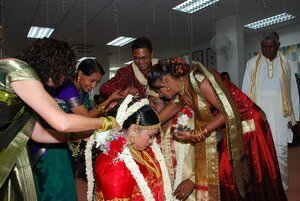
"I pray to the Almighty that I be blessed with a long life. I tie this knot around your neck. Oh Sowbhayam, May providence bestow on you a fulfilling life for a hundred years to come!"
He then takes the 'Thali' from an elder of the family or the centre chief and ties the first two knots around the bride's neck. Generally, the groom ties the first two knots and his sister ties the last one.
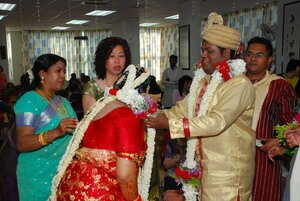
Turmeric and 'kumkum' are smeared on the 'Thali' and the three knots. The couple exchange garlands three times. They then get the blessings of the elders.
It has to be noted that ladies must be married not widow, divorce or separated to help in any wedding function. Sad but true.
Treading on the Grindstone
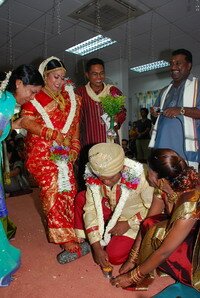
Holding the bride's left toe the bridegroom helps her to tread on a grindstone kept on the right side of a fire.
One Indian mantras which we love says: Mount on this stone, and let thy mind be rock firm, unperturbed by the trials and tribulations of life. This ritual is symbolic of the solid rock foundation for the union.
Solemnizing the Marriage
Nowadays the registrar of marriage can solemnize the marriage outside the Marriage Registrar. You first need to report back to the town or district you are presently staying.
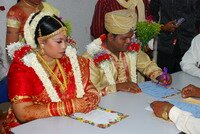
For Jivan and Uvaraani case, they went to Kuala Muda district marriage registry to have the marriage date confirm.
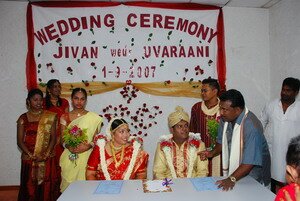
So on the wedding day, the Registrar of Marriage solemnizes the marriage in the presence of all friends and relatives right in the matrimonial hall.
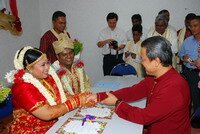
Here again, they got themselves tied "tighter" into the marriage as they exchange their marriage vows twice. One with the registrar or Marriage and the other with the Buddhist Dojo chief.
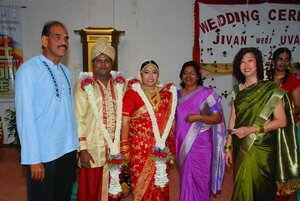
As can be observed, we tried to maintain the symbolic Indian marriage as possible because the time for Jivan to tie the Matrimonial knots "Thali" must be respected.
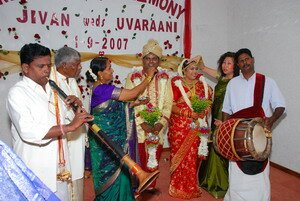
There were many other things that can be deleted and omitted but the timing needs to be observe. Whatever you may say, marriages for the Chinese and Indians alike are still made in heaven.
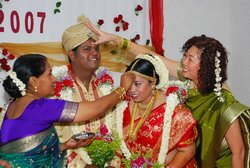
And you thought you fell in love and wants to be together? Well, need an Wedding Planner, talk to Ganesan, our Indian Wedding planner and food caterer.
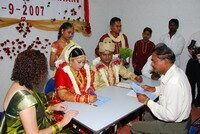
Certain Hindu Translation
Nadaswaram : Traditional South Indian music ensemble including the tavil (drum), nadaswaram (a sort of wind nstrument) and small cymbals.
Kolam or Rangoli : Designs made on the floor with rice flour paste
Sowbhayam : Literally meaning good fortune. It is intended to be the good fortune of never being widowed.
Go to the top of Indian Wedding Page
Back to Indian Wedding Rituals Page
Back to Indian Engagement Page
Back to photos of Indian Engagement Page
Back to Malaysian Indian Engagement Page
Back to Puberty Ceremony Photos Page
Back to Indian Decorators Page
Back to My Island Penang Home Page