The Charcoal Factory in Kuala Sepetang, Taiping has been with Mr. Chuah Chow Aun's family since 1940.One can not helped but listen to him telling us his passion on charcoal.
He is hands on in all the process from coming and going of the tides to the various other process in building the kiln and baking of the charcoal.
What was news to me is that the ebony black charcoal is the result of baking to reduce moistures of green wood or bakau log in the kiln and not burning it.
These caught all my attention and I admit I better listen to what Mr Chuah has to share about Charcoal Factory processes.
In case the page is too long for you, check it out here:
- Making of the furnace or igloo-like kiln
- Harvesting the bakau logs
- Cutting the Bakau Tree
- Transporting the bakau logs for baking
- Baking in the igloo-like kiln
- Final Packing
- Some Charcoal uses
- A surprising by-product
It is very interesting to note how these furnace or igloo-like kiln are made. Bricks are stacked and cemented with clay in a diameter circle of 3 meters.
They would built the igloo-like kiln till it reaches the 7 meter dome like top. There is only an opening for a man to carry the bakau or green wood log.
We noticed some small hole openings on the middle of the kiln. We were told that it aids as air vents and opens and closes to help in the combustion process.
The choice to use clay made sense as once the process is over, it is easy for the workers to break down the Charcoal Factory.
Now do you wonder how the charcoal factory is sealed? And how the man lands himself on the ground after sealing it? Write to me if you need the answers. It would be fun to know your answer.
One of the questions thrown to Chuah was whether the supply of logs could meet the demand that has soar over the years. Chuah went on to explain about the how the green wood or kayu bakau minyak are harvested from the 40,000ha forest reserve.
Being one of the 100 charcoal factory owners, they rotated harvesting the green wood or kayu bakau logs by the system set from the State Forestry Department.
Since the State Forestry department reviews their logging activities every 10 years, the 100 charcoal factory owners would wait for instructions on where is their next harvest is going to be. Presently, there are over 100 charcoal makers who has 380 kilns in Taiping.
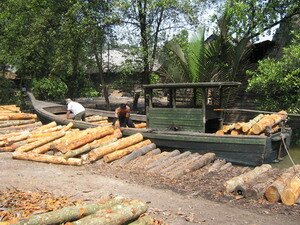
Most logging activities in Kuala Sepetang depended on the tides and boats. In the morning, the boat takes their workers to the allocated part of forest reserve.
Cutting and falling of the trees and debarking is handled in the forest. The ideal length for cutting the log is 1.6m. Debarking helps to cut down on excess moisture in the green wood or bakau minyak logs.
By afternoon, they got to work real fast as the tides comes in, the logs have to be carried and stacked in the boats. Then the boat ply its way back to the factory.
I must say I have a lot of respect for these hard and sun tanned healthy working man.
I thought Nyonya cooking is laborious. Now you need plenty of patience and hard sun tanned healthy working man or ladies to work in Kuala Sepetang Charcoal Factory.
Mr Chuah casually chides he needs to pass on his skills and experience. Anyone able man applying? As we look around us, we cheekily told Mr Chuah his workers are his incredible hulks.Charcoal Factory
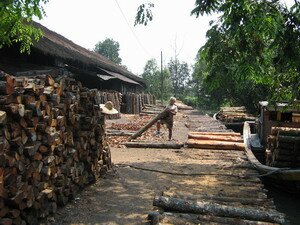
Imagine a bakau minyak log is weighs over 25 kgs per log and he carries to and from the boat and then unload and carries all the way to the igloo-like kiln.
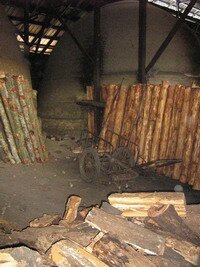
After the bakau minyak log are carried into the kiln, it is stacked by the side of the kiln to dry out.Charcoal Factory
From day one of cutting the green wood till it turns charcoal, Mr Chuah explained it is a month of hard work. The scientific name for these trees are Rhizophora apiculata or Rhizophora mucronata and its local name is just green wood or in Malay bakau minyak.
This is the vital part of the baking process called combustion. To help the combustion and consistency of the baking process, stacking of the bakau log are an important factor.
The workers stacks the bakau minyak logs on both sides of the kiln till it leaves a path for him to walk. Then he maximizes the area by stacking on the top of the first layer carefully making sure air circulation is possible.
Air circulation is important to ensure even premium quality of black shiny ebony charcoal.
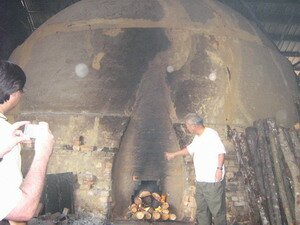
1st baking
Once both sides of the kiln are filled up in its capacity, the path where the workers walked is now filled with twigs and branches. Nothing goes to waste here as these twigs and branches are lighted for the combustion process.
For 8 to 10 days, the baking with the temperature of 220 deg centigrade go on to remove moisture from the wood.
During this process, the headman monitors the fire, baking and temperature to attain good quality charcoal. If air circulation is block,the quality is affected and so is the pricing.
This is a real delicate process as only the "master smeller" knows when to switched the temperature to precisely 83 deg centigrade.
Mr Chuah's "master smeller" controls the temperature with his natural sense, his nose! Imagine him smelling the heat and knowing, ahh it is 220deg and then after 10 days, ahh this is 83 deg.
It is no laughing matter as this age old practice is still carried out today despite having modern technology. And he can even tell you, too high or too low the heat would effect the quality of the charcoal.
2nd baking
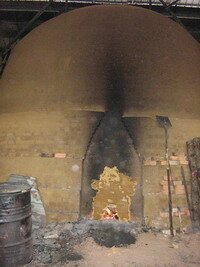
After the 8 to 10 days of high heat baking, smelling the texture and humidity and moisture, the worker upon the advise of the master smeller now checked all the air vents.
The fire is now bought down to 83 deg centigrade and further baked for another 12 to 14 days. They will block all the air vent and the entrance door tightly. They will completely sealed the entrance with yellowed clay.
Brick are stuff at the air vent in the kiln. No air will pass through and allow the carbonization process to begin.
Each igloo like kiln can stacked up to 40 tonnes of green wood. The final product after combustion and baking is approximately 10 tonnes. Matang charcoal is priced at RM600 per tonne.
Cooling down
Approximately 20 to 24 days are baking, the totally baked and carbonized charcoal is left to cool down inside the kiln for another 8 more days.
Once the 8 days of cooling period is over, the entrance is broken down for the workers to begin carrying the ebony black charcoal (black gold to them) out ready for final packing.
You would think that cooling down means it is cool inside ready for the incredible hulk workers to begin taking the ebony black charcoal out.
As we were lucky, Mr Chuah invited us to have a 20 mins sauna in this kiln. It is still pretty warm (hotter than a normal day temperature, I would reckon). Oh boy! how we sweat in the dark igloo like kiln.
The beautiful baked pieces still intact are carefully selected and packed for export. The bits and pieces, or broken logs are packed in 5 kgs packs for local consumption. Even the tiny bits are not wasted.
We totally enjoyed our Charcoal Factory visit. We were very pleased with Mr Chuah clear and concise explanation. This man is the pride of the nation with his love for his Charcoal and his workers.
The Asian mostly uses charcoal for barbeques and steamboats. While the Japanese uses it for filtering the air and water. Even cleaning their teeth.
Cleaning the teeth with charcoal was also practiced by the Chinese. I remember my dad said charcoal whiten our teeth.
Some Chinese even tie two pieces with red ribbon and place them on the doorstep. It is very symbolic for Chinese to ask for blessing or prosperity.
Mr Chuah shares some latest information of the wonders of the "charcoal water". Remember the combustion process? Which reduces the moisture from the green wood?
Well these moisture were collected via a pipe to the barrel. The locals would come and collected these "charocal moisture" water as they believed it has healing properties.
Go to Top of Charcoal Factory Page
Back to My Island Penang Home Page