Indian Engagement (Parisam) is the beginning affair to any Malaysian Indian Weddings. Most Weddings kicks off with an engagement announcement to the relatives and friends.
In the past, girls before engagement or wedding must not be seen going out with boy friends. It hasto be the intended husband who can take the lady out roaming the town. So to stop gossiping, the couple has to be engaged, to be seen together.
Those were the old days, not sure whether I should say good or bad practices. But it does have some good points.
And the good point as parents, I believe is that we get the news and be informed by the kids in the first place. It would sometimes be terrible to be told by others and not by them. Look for the sub titles if you feel the pages is too long for you:
Well, usually Indian traditions regards wedding to be a very important events of any child life. Traditionally, in the olden days, marriages are arranged and elders are consulted before Any wedding arrangements are prepared.
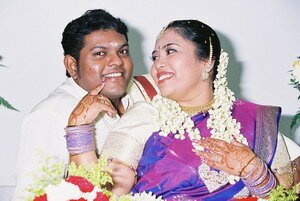
In the case of both Jivan and Uvaraani, they met and fell in love while working. Found each other and still have the filial obligation to inform both parents of their intention.
As parents, excited as ever after some hassling and what nots, all preparations, like seeking our elders advices were one for the happiness and success of their coming marriage.
The Jatakam practice was still done despite falling in love. For most arranged marriages, the Jatakam is most important checkpoint for both parties.
Jatakam practice is a traditional practice of checking the horoscope or books of Omens. By comparing both their horoscope to ensure compatibility before the engagement date is set.
The engagement, with all the prom and gaiety of a wedding, just short of a "thali" is being held in the bride's residence. Some holds it in community halls or Indian Temples.
For us, we choose to have good things happening in the homes. So we choose to have the engagement in our residence. Usually, the residence will be packed with relatives staying over in preparation for the Indian engagement.
Now being a Chinese, I would not know much about the Indian customs and traditions but I do know one thing. Customs and traditions are part of our lives, no way we can run away from it.
I helped and be a amicable hostess in spite of all the Indian talks and mutterings. I cooked and showed off my cooking for the whole crowd of twenty relatives.
I did not poison anyone nor any had diarrhea after eating. So not bad for a Chinese cooking for the Indian crowd.
Beside getting the bride's ready for the Indian engagement, the cousins were here to decorate the house.
So Chandra's cousins, his blood sisters or cousins were in our house 2 days before hand to help out in all preparations. And I do mean all preparation. Decorating the home, inside and outside.
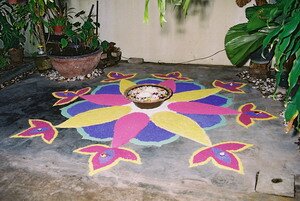
Thuruga, our niece draws the "Kolam". It seems the "Kolam" is made for the smaller creatures. Humans happiness is equally shared with the smaller creatures in our surroundings.
Kolam are usually rice flour,coconuts, or raw rice. To make the "kolam" beautiful, color are added to the charm the design. If you reared chicken at home, then coconut would be prepared for them. See more kolam designs here.
Preparation for the priest prayer, the oil lamps to be lighted and many other ceremonious things like flowers, turmeric is prepared by the aunts.
Furniture to be clear to make way for the ceremony. The aunts polishes the bronze or silver wares for use. Wedding planners were in the house decorating the dais for the couple to be seated.
A day before, the Indian Mehendi lady comes over to the house to decorate both her hands and feet. Mixing wet henna she then pumps it onto her hands and feet.
The whole process takes 2 to 4 hours to complete. It is no fun sitting upright for a few hours for this process (drawing, design and dry of the henna).
The next day her indian engagement day, Uvaraani sits through her hairdo. Traditional hairdo with plenty of flowers are tied up with false hair to make a long pleated hair.
She is dressed up to look presentable to receive her Indian engagement sari. Read more of Henna body art and traditions here.
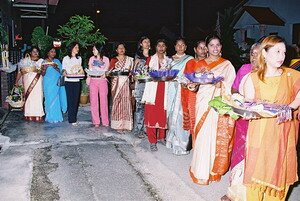
Jivan was dressed in his best suit. Nine to fifteen trays of sweet offerings are bought to the bride's residence together with the engagement attire for the bride.
His mother, sister and relatives will come to the bride's house with gifts. The engagement sari and flowers for the Indian engagement will be presented to the bride and she will then changed into the engagement sari after the prayers are completed.
Usually the Engagement is held in the evenings and dinner offered by the bride's father ends the happy ceremony. The entourage for the groom is announced by the Indian trumpets and drums.
Once the entourage arrived, nine to fifteen ladies will assembled together with gifts and the engagement sari, enters the bride residence.
The bride's family will also arrange for her entourage to received the groom offerings. Smiles and greetings of hello are the introduction as the trays of goodies were passed and laid on the floor.
In the old days, dowries are a big part of the Indian engagement. Parents and both the bride and groom and senior family members will sit down for this part of the ceremony.
The priest performing the ceremony, also ask how much dowries will be given by both parents and then announced to the crowd. The crowd usually lends a bigger and wider ear to this BIG DEALS.
In the past, many family feuds happen due to promises not fulfilled as relatives who listened and remembered, gossiped amongst themselves.
Nowadays, both parties would mostly confirm the wedding dates, types of mutual exchanges, and the number of attendees for the wedding.
We told the priest that whatever was agreed during the ceremony in the eyes of the Gods, it remains with the eyes and ears of the Gods. But that does not stop the relatives from trying to see what the groom family sends in the fifteen trays of goodies.
Definitely, there is a tray of her Indian engagement sari, her Indian engagement flowers, their agreed jewelries and sweet offerings.
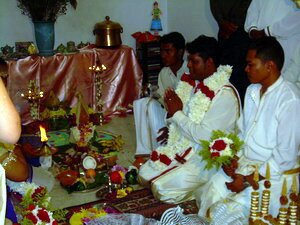
After the prayers and announcement of agreed marriage dates, the engagement sari is presented to the bride as she completes the engagement rituals.
Her entourage will then take her to change into her engagement sari to signify accepting the proposals by both families.
Parents will then exchange and accept each other trays loaded with betel nuts, sireh and coconuts is a sign of agreeing to the deals presented by the priest.
Well, hereare more pictures of Uvaraani and Jivan Engagement ceremony.
She will then be dressed and comes down to be engaged to the groom. Exchanging of rings is seen by all and elders will take turns to bless the new couple. Before that, the couple will both bow to their parents consecutively for blessings.
I reckon in most traditional Malaysian Wedding or Indian Wedding, blessings from parents or elders are the integral part of the ceremony.
Two whole days of hard work ends in just half hour of prayers. How about that? Look out for other ceremony before the actual THALI Tying ceremony. You can see more photos of Engagement of Yuvaness and Saravanam (Uvaraani's cousin) here.
Go to Top of Indian Engagement Page
Back to Indian Wedding Rituals Page
Back to Malaysian Puberty Ceremony Page
Back to Photo of Engagement Page
Back to Photos of Malaysian Engagement Page
Back to Puberty Ceremony Photos Page
Back to My Island Penang Home Page