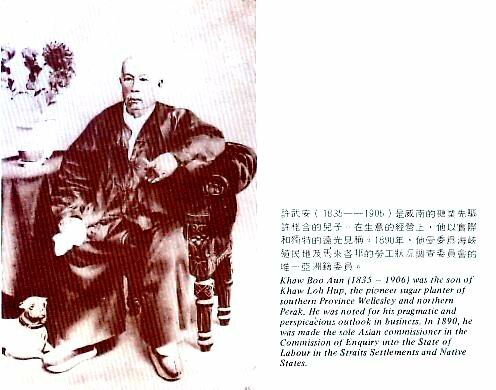
Khaw Boo Aun, the son of Khaw Lau Hup was the Batu Kawan sugar cane magnate in his times. The Teochiews or Teochews during his time owned over 20,000 hectares of sugar cane, employing 9,000 employees.
Khaw Boo Aun had over 2400 hectares and was supervised by Chor Chor Kee Lai Huat. A second generation Teochew community leader of the 19th century Penang and Perak. The pioneering sugar planter of Southern Province Wellesley and Northern Perak.
He was also the founder of Hang Kang Keh Beow, Penang in 1864. Khaw Boo Aun (1835 - 1906) was noted for his perspicacious outlook.
He was the Sin Seh(in those days means Second man or secretary) of the Ghee Hin Sum Hup society and played an instrumental part in the 3rd Larut War (1871- 1873) as the financier to Raja Abdullah.
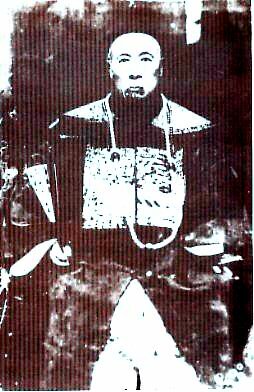
Khaw Boo Aun was made a member of the Perak State Council in 1886. He served many years as a member of the Chinese Advisory Board since its inception in 1890.
Khaw Boo Aun was the principal of Kwantung and Tingchow Public Cemetery committee and co-founder of Penang Chinese Town Hall and Seh Khaw Kongsi.
Khaw Boo Aun was also appointed as the sole Asian commissioner in the commission of enquiry into the state of Labor in the Straits Settlements and protected Natives States in 1890. He served as a Justice of Peace one year before his death in 1906.
He died in 1906 Jan 8th, the coffin was in state in his Bukit Tambun house for 3 years before it was transferred back to China for burial.
As for control over his coolies and plantation, it was no surprise he ruled them strictly and fearlessly thus quotes like "As the saying goes at that time, not even a bird can fly out of Boo Aun's estate due to the tight security imposed", Ong said.
Or Wu Liu quote like " the wealth of Kang Hock (district or community) with the influence of Boo Aun". Such was the power of Khaw Boo Aun, the leader of Ghee Hin triad society during 1829 to 1874.
In 1736, according to Malaysian Chinese History & Relic Survey (MCHRS) deputy director Ong Seng Huat, the Teochiews had begun emigrating from provinces like Cheng Hai, Tai Pu, and Zhou An to South East Asia.
These are districts of the Teochews county in Swatow (Guangdong) Cheng Hai and Zhou An, located at the river mouth of the Han Chiang River, are well-known sugarcane-producing areas since the Qin Dynasty (255BC-206BC).
"Tai Pu, which was once known as Ghee Aun, was regarded as the hometown of the Teochews during the reign of Qin emperor Shih Huang Ti," Ong said.
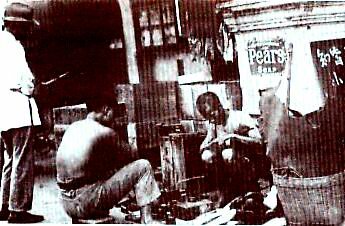
As early as the 19th century an estimated 1.5 million Teochews had left their hometowns.
"According to Victor Purcell, a scholar of Southeast Asian history as early as the late 18th century the Teochews were already working as sugarcane planters in Batu Kawan."
"The chief police officer of Penang, Capt James Low, also showed in his Dissertation on the Soil and Agriculture of the British of Penang that in 1836, the Taochiew community owned 364ha of land in Batu Kawan," said Ong.
When the Perak and Province Wellesley governments exempted export-oriented businesses from taxes in 1860, they also attracted many Teochew, Cantonese and Hokkien settlers.
Such taxes were removed because the governments wanted to encourage the exportation of items such as sugar to Penang and other British colonies.
The policy prompted the Teochews, Cantonese, anti Hokkiens to clash over plantation and tin mining rights in Perak, leading eventually to the bloody Larut Wars involving the two main secret societies, the Ghee Hin and Hai San.
The Larut war was a 14-year-long conflict. Prior to the signing of the Pangkor Treaty on 3rd January 1873, Khaw Boo Aun alias Booy Aun accompanied Chin Ah Yam, met W A Pickering for an unofficial preliminary negotiations of the Penang Triad Society.
Their co-operation with Pickering paved the way to the signing of Pangkor engagement 20th January 1874.
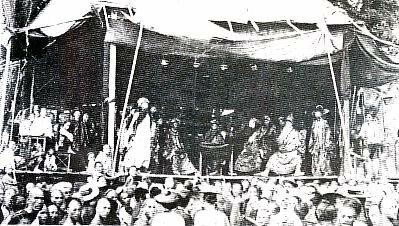
A much more extensive page about Larut Wars is written by Peter, who stays in Sitiawan.
Read from Peter, a Dutch man who has been living in Sitiawan for the past three years. He wrote an excellent page about Larut Wars and Pangkor Treaty.The British at first hesitated to intervene.
But when Boo Aun imposed a blockade for about six months in the water route stretching from Perak to Penang, preventing tin ore from being shipped out of Klian Pauh controlled by the Hai San.
The British forced the two warring secret societies to sign the Treaty of Pangkor in 1874 which ended the bloody conflict.
This history of Khaw are now only whispered among few as there are too embarrassed to be associated with Triad society. But during the 19th century, it was an accepted fact.
This has to be explained that it is in no way derogatory for a Kapitan in the period under review to be associated with any of the triad society which were tolerated and officially recognized and registered in the Straits Settlements as late as 1869.
Although Khaw Lau Hup, father to Khaw Boo Aun stayed in the mainland, they asserted their presence as a dialect group.
Khaw Lau Hup and the Teochiews contributed $234 (Spanish dollars) to the building of a Guangdong cemetery in Mount Erskine Penang in 1828.
The Guangdong-Thengchew cemetery was jointly shared by Hokkiens and Taochiews as they has similar culture in China.
Wan Shi An Temple Temple and Penang Teochew Association
The senior Khaw was a generous man too, is the founder of the Han Jiang Clan Temple in Bukit Tambun. Khaw Boo Aun in turn built Wan Shi An Temple in Batu Kawan.
Having carried on his father good work, he extended the Penang Teochew Association into a magnificent three hall structure.
Penang Teochew Association won the UNESCO 2006 Award for being the only example of traditional Teochew architecture in Georgetown Penang.
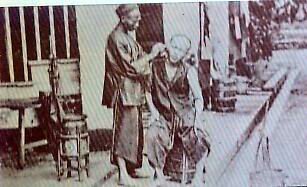
And also he was a modern man as he could foresaw the prosperity coming to him, by hiring English manager to manage after Chor Chor Kee Lai Huat went to built his own township.
There was also a Quangdong Taochiew pavilion in the cemetery donated by the two dialect groups.
"Among the donors was a Teochew, Khaw Lau Hup, who contributed $6, which is three times the amount of a monthly salary earned by a worker at that time." Quoted Mr Ong.
Though the Province Wellesley Taochiews were involved with the Johore political intrigues, there were no mention of Khaw Boo Aun in it.
Source from Xiao organization on preserving cultures in Malaysia. Look at Xiao En magazine, Cultural Conservation, A formidable Community.
Go to Top of Khaw Boo Aun Page
Back to Kee Ancestral Home Page
Back to Kee Kongsi Cheng Beng Page
Back to Kee Clan All Souls Day Page
Back to Kee Lai Huat Vision Page
Back to Province Wellesley Taochiews Page
Back to Kee Ancestors Lineage Page
Back to My Island Penang Home Page